
Research
AI Infra
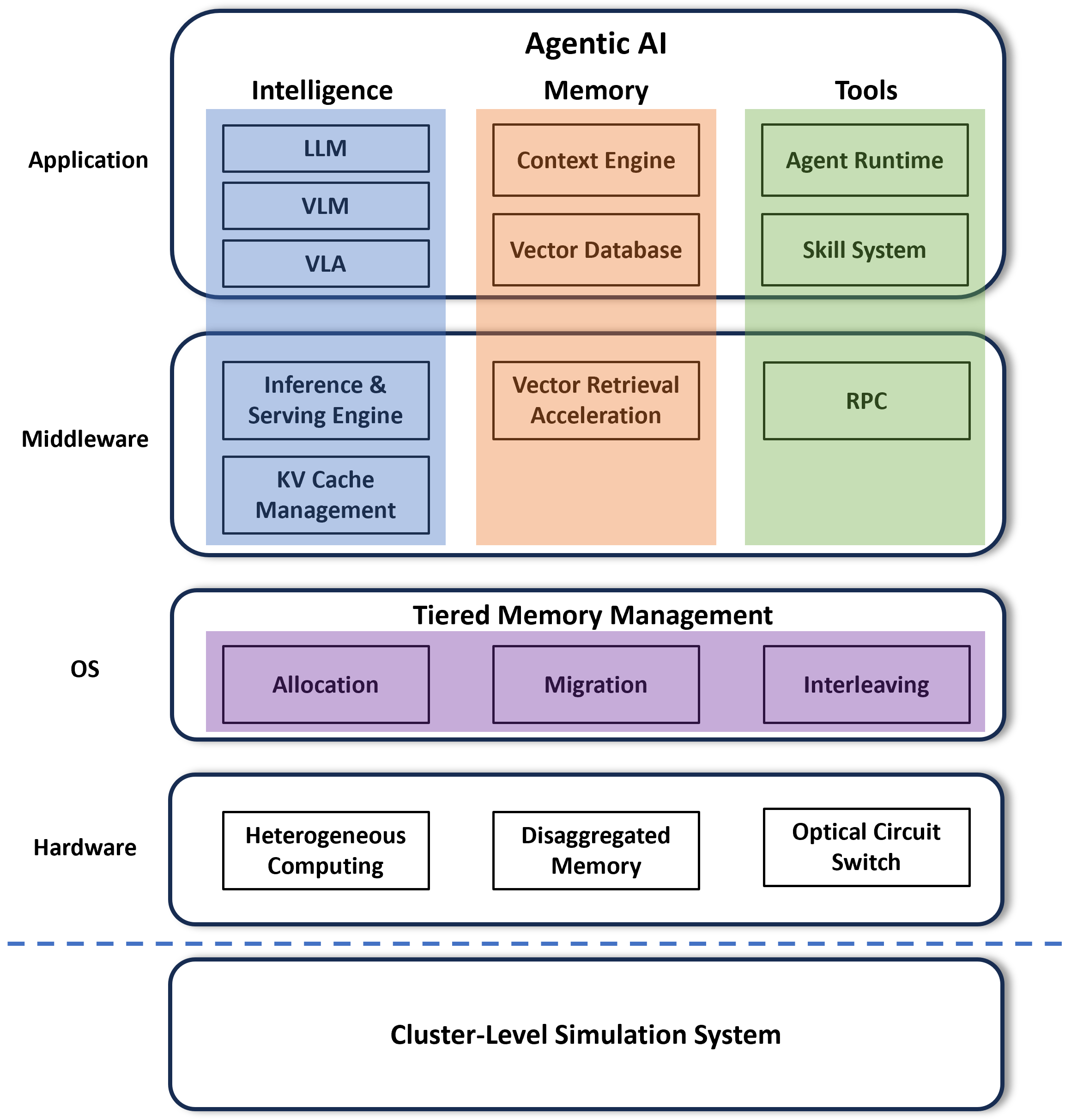
- F. He, C. Ye, H. Cai, Z. Lv, B. Cui, W. Yan, C. Zhan, Z. Zhang, H. Yi, J. Xiang, X. Li, Y. Gai, Z. Zhang, P. Zheng, and Y. Du, “Ascend-rabitq: heterogeneous npu-cpu acceleration of billion-scale similarity search with 1-bit quantization,” arXiv:2605.16007, May, 2026.
- F. He, T. Fang, H. Cai, B. Cui, Z. Zhang, Y. Yao, X. Li, L. Du, C. Ye, P. Huo, B. Gao, Y. Zhang, P. Zheng, and Y. Du, “Memflow: characterizing memory traffic contention in disaggregated architectures,” to appear at 63rd ACM/IEEE Design Automation Conference (DAC), Long Beach, July, 2026.
Previous Work on Network Virtualization/Softwarization and Optical Networks
Driven by the exponential growth of global data traffic, the next-generation networking paradigm encompasses network virtualization/softwarization and high-capacity optical networking as its key pillars. By leveraging software-defined networking (SDN), network function virtualization (NFV), and computer virtualization, this domain addresses the ossification of legacy architectures to enable flexible network management and efficient resource allocation under stringent reliability and latency requirements. To support this agile control plane with robust physical transmission capabilities, this line of inquiry extends to emerging optical technologies, particularly elastic optical networks (EON) and space division multiplexing (SDM) networks. Ultimately, our research aims to realize resilient, scalable, and high-performance future networks powered by these advanced softwarization and optical transport technologies.
- F. He, M. Ito, T. Sato, and E. Oki, “Probabilistic protection for both computing and transmission capacities of virtual networks under multiple facility node failures,” IEEE Transactions on Network and Service Management, vol. 21, no. 4, pp. 4563-4582, Aug. 2024.
- F. He and E. Oki, “Preventive priority setting against multiple controller failures in software defined networks,” IEEE Transactions on Parallel and Distributed Systems, vol. 34, no. 8, pp. 547–562, Aug. 2023.
- F. He and E. Oki, “Service deployment with priority queueing for traffic processing and transmission in network function virtualization,” IEEE Transactions on Network and Service Management, vol. 20, no. 4, pp. 4861–4874, Dec. 2023.
- F. He and E. Oki, “Robust virtual network function deployment against uncertain traffic arrival rates,” in Proc. IEEE NetSoft 2021, Online, June 2021, pp. 339-347.
- F. He and E. Oki, “Backup allocation model with probabilistic protection for virtual networks against multiple facility node failures,” IEEE Transactions on Network and Service Management, vol. 18, no. 3, pp. 2943-2959, Sept. 2021.
- F. He and E. Oki, “Main and secondary controller assignment with optimal priority policy against multiple failures,” IEEE Transactions on Network and Service Management, vol. 18, no. 4, pp. 4391-4405, Dec. 2021.
- F. He, T. Sato, B. C. Chatterjee, T. Kurimoto, S. Urushidani, and E. Oki, “Robust optimization model for primary and backup resource allocation in cloud providers,” IEEE Transactions on Cloud Computing, vol. 10, no. 4, pp. 2920-2935, Oct.-Dec. 2022.
- F. He and E. Oki, “Unavailability-aware shared virtual backup allocation for middleboxes: a queueing approach,” IEEE Transactions on Network and Service Management, vol. 18, no. 2, pp. 2388-2404, June 2021.
- F. He, T. Sato, and E. Oki, “Optimization model for backup resource allocation in middleboxes with importance,” IEEE/ACM Transactions on Networking, vol. 27, no. 4, pp. 1742-1755, Aug. 2019.
- F. He and E. Oki, “Shared protection-based virtual network embedding over elastic optical networks,” IEEE Transactions on Network and Service Management, vol. 19, no. 3, pp. 2869-2884, Sept. 2022.
- B. C. Chatterjee, F. He, E. Oki, A. Fumagalli, and N. Yamanaka, “A span power management scheme for rapid lightpath provisioning and releasing in multi-core fiber networks,” IEEE/ACM Transactions on Networking, vol. 27, no. 2, pp. 734-747, Apr. 2019.